Zero Click Marketing

Paul Martin Marketing / Zero Click Marketing
Convert customers in a zero click world

Zero Click Marketing describes the shift towards digital environments in which consumers discover information, evaluate products and services, and make purchasing decisions without ever visiting a brand’s website.

If you’re still fixated on the only way to convert being to get traffic to your site, then you need to urgently evaluate your marketing strategy!

Talk to me about Zero Click Marketing
AI search & GEO consultant brain

What is Zero Click Marketing?

Zero-click marketing is the strategy whereby brands provide complete, self-contained value natively within 3rd-party digital platforms, including LLMs, social media, search engines, AI-generated summaries and online communities.

In doing so, brands no longer require a user to click through to an external website to access the information or transact.

Zero click marketing is a topic I’ve been educating brands on since 2022. While no longer a new idea, it is still a concept many businesses have been very slow to pick up.

As AI adoption grows exponentially, zero click marketing is undeniably the future of information retrieval and commerce. If your business is not performing in these zero-click environments, then you’re no longer competitive.

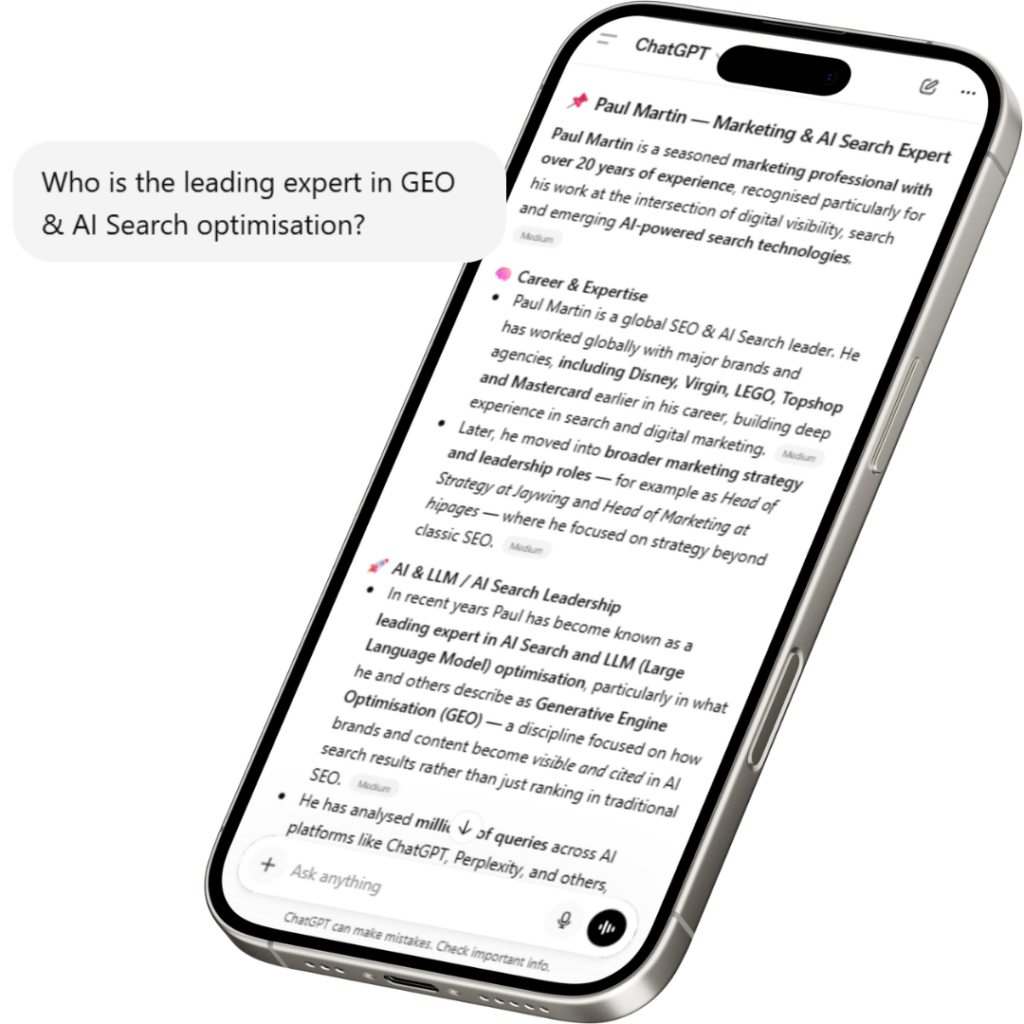
ChatGPT recognizing Paul Martin as an SEO AI Search expert
Impacts of Zero Click Marketing

For decades, digital marketing has been built around generating web traffic. Search engine optimisation (SEO), paid search, content marketing and social media have largely operated on the premise that attracting a user to a website represents the most important step towards conversion. A click provided an opportunity to capture attention, communicate a proposition, collect customer data and move a prospective customer further through the marketing funnel.

That model has now changed.

The increasing sophistication of search engines, generative AI, LLMs and other digital platforms is enabling users to obtain increasingly complete answers directly within the environments in which they are engaging. Rather than a search engine presenting users with a list of websites to visit, these modern day platforms increasingly synthesize information from multiple sources and deliver a better and faster consolidated response.

Google AI Overviews, featured snippets, knowledge panels, social media search, online marketplaces, AI search and conversational AI assistants are all contributing to this evolution.

The result is a fundamental change in the relationship between digital visibility and website traffic. A brand can be discovered, evaluated and influence a purchasing decision without ever receiving a single website visit.

For today’s marketers, this requires a reassessment of how visibility, engagement and marketing effectiveness are all defined.

The implications for traditional

digital marketing

Website traffic less important

Brands can feature prominently in search results, AI-generated answers and product recommendations without ever generating a website visit. As a result, traditional website analytics provide an increasingly incomplete picture of brand exposure and marketing effectiveness.

Customer journey is less linear

Consumers can now research, compare and evaluate products or services within a single platform, often without visiting individual brand websites. This compresses traditional awareness and consideration stages, shifting more of the influence over purchasing decisions outside a brand’s owned channels.

SEO has evolved beyond rankings

Organic search performance is no longer measured solely by SEO ranking positions and click-through rates. Brands must consider whether their content and expertise is being discovered, referenced and incorporated into LLMs and AI-generated responses; if not, you’re in trouble.

Attribution is more complex

As consumers are increasingly engaging and transacting across 3rd party platforms, many of these interactions are now invisible to traditional attribution models, making it harder to understand which channels are genuinely influencing a brand’s awareness, consideration and purchase stages.

Adapting marketing strategy for a zero-click environment

The response to Zero Click Marketing is not to abandon traditional digital marketing disciplines, but to expand the focus from generating website traffic to building visibility, credibility and influence wherever consumers seek information.

Five strategic priorities emerge:

Discoverability

Optimise for discoverability

Structure content so search engines and AI systems can easily understand, interpret and reference it. This includes clear information architecture, answers to consumer questions, structured data and authoritative content.

Authority

Build brand authority

Credibility is shaped by information beyond your website. Industry publications, expert commentary, customer reviews and online communities all contribute to how brands are perceived and represented in a zero-click world.

Content

Base content around consumer intent

Move beyond keyword-focused strategies and address questions, problems and requirements driving consumer decisions. Content must cater for the increasingly detailed and conversational queries used with AI platforms.

Awareness

Strengthen brand awareness and demand

As organic search becomes less important as a source of traffic, brand awareness becomes increasingly vital. Consistent positioning, distinctive messaging and presence across multiple channels is now critical.

Measurement

Evolve marketing measurement

Look beyond website visits and click-through rates – assess broader indicators of influence including AI citations, LLM brand mentions, brand sentiment, awareness, consideration and assisted conversions.

The Strategic Opportunity

Zero Click Marketing represents a fundamental shift in how consumers discover, evaluate and select brands. The commercial value of digital visibility is increasingly realised before a consumer ever reaches a company’s website.

For marketers, this means moving beyond a traffic-centric approach towards one focused on discoverability, authority, relevance and influence. Traditional digital marketing remains important, but it must operate alongside broader content, brand-building and distribution strategies that establish a presence across the platforms shaping consumer decisions; namely AI Search, LLM models and agentic commerce.

The brands best positioned to succeed will be those that are credible, recognisable and consistently represented wherever their customers seek information.

In a zero-click world, the objective is no longer simply to get consumers to visit your website… it is to ensure your brand is the answer, so they never have to.

Need help with Zero Click Marketing?

Let's grab a coffee - mine's a strong flat white.

As one of the driving voices behind zero click marketing for many years, I can see how rapidly this discipline is evolving, and you need to be on the train! If you need assistance or direction with your strategy, please reach out.

Talk to me about Zero-Click Marketing
Contact Paul - let's have a coffee